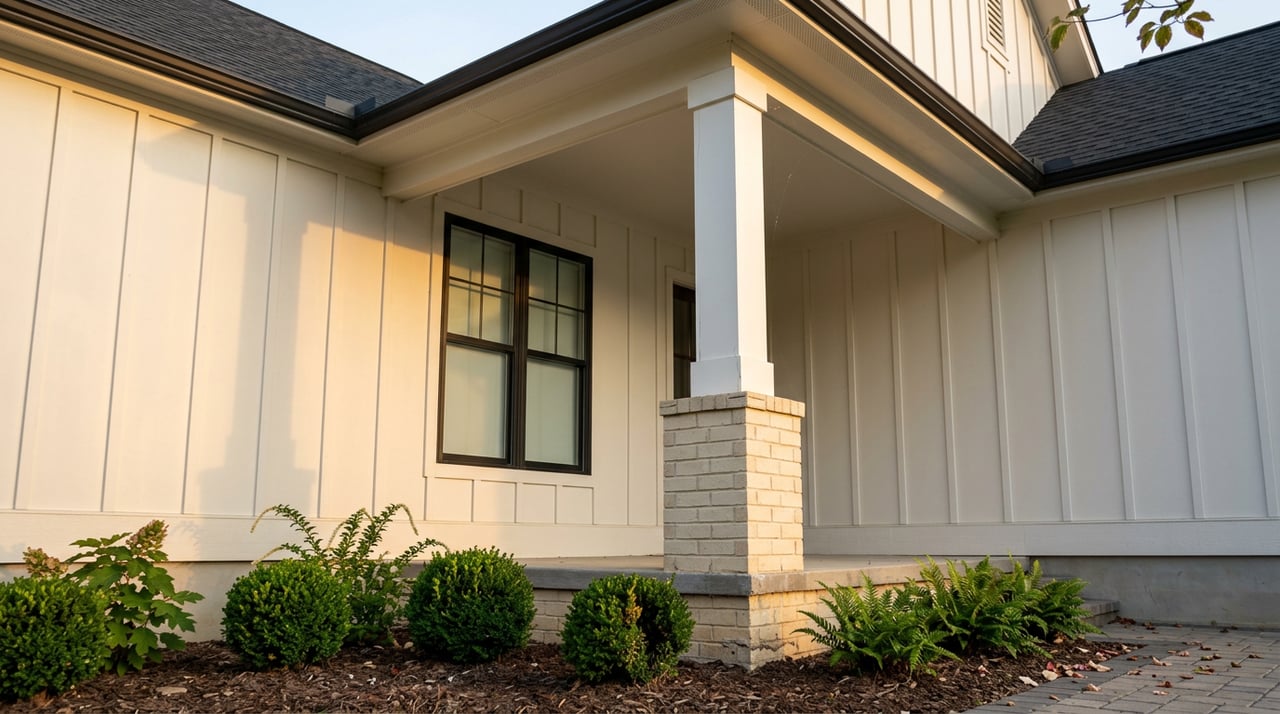
Why Murray, Kentucky Doesn't Have One Median Home Price
September 17, 2026
September 17, 2026
Open four tabs on Murray, Kentucky real estate right now and you will get four different answers to the same question. One site pegs the median sale price at $195,000. Another, pulling from the same general window, says $195,859. A third puts it at $313,500. A fourth, using a full month of closed sales in July, lands at $270,000. All of these are current. None of them is lying. And if you are comparing Murray to another Western Kentucky town while trying to figure out what your money actually buys here, that spread matters more than any single number on the page.
The instinct is to assume one source made a mistake, or that the market moved that fast between reports. Neither is quite right. What's actually happening is a mechanical problem: Murray is small enough, and its housing stock is split cleanly enough, that a citywide median stops behaving like a stable measurement and starts behaving like a coin flip.
Here is what four different reports said about Murray home prices in 2026, side by side.
| Source and time window | What it measured | Reported median |
|---|---|---|
| National sales-tracking site, February 2026 | 6 homes that closed that month | $195,000 |
| Independent home-value forecasting model, mid-May 2026 | Estimated citywide median | $195,859 |
| A local market report, mid-May 2026 | Homes sold that same month | $313,500 |
| Calloway County FlexMLS Residential Market Summary, July 2026 | Homes sold that month | $270,000 (average sale price $298,034) |
Two of those rows cover the same month and differ by more than $117,000. That is not rounding error. That is what happens when a "median" is calculated off a handful of transactions instead of hundreds.
A median is only as stable as its sample size. The February 2026 read of $195,000 was built on six closed sales for the entire month, down from thirteen the year before. Six sales. In a market that small, one $500,000 lake-adjacent property closing instead of a $140,000 starter home doesn't nudge the median. It relocates it.
Murray's housing stock makes this worse, not better, because it isn't a smooth range of prices from low to high. It's two distinct clusters. On one end sits the stock built around Murray State University: rental duplexes, converted houses, and modest single-family homes concentrated near campus. On the other sits everything else, larger single-family homes, homes closer to Kentucky Lake, and properties that never touch the student market at all. There is very little in the middle to smooth the transition.
When a month's closings happen to lean toward the campus-adjacent cluster, the median drops. When they lean toward the other cluster, it jumps. A citywide median in Murray isn't describing "the market." It's describing which of the two clusters happened to trade that month.
There's a second layer here that most comparisons skip entirely: Murray State's own housing rules shape when and how that campus-adjacent cluster turns over.
Murray State's preliminary fall 2026 enrollment count came in at 9,982 students, up 1.1% year over year, and the entering freshman class grew to 1,523 students, up 2.2%, the third-largest incoming class in the past decade and the one with the highest average high school GPA of any class in that span. On the surface, that reads as straightforward good news for anyone holding property near campus. More students should mean more renters, which should mean stronger demand.
It's not that simple, and the reason is policy, not preference. Most Murray State freshmen and sophomores are required to live in university housing for their first two years, with exemptions for students who turn 21 before the semester starts, those who are married or veterans, and students commuting from a parent's home within 50 miles. That means a bigger freshman class doesn't show up as new off-campus renters this year. It shows up two years later, if those students stay in Murray and choose to move off campus at all, into the same established rental pockets around North 16th Street and Chestnut Street.
For anyone comparing Murray's numbers to another town's, this matters because it means the campus-adjacent housing cluster runs on a lag. Enrollment growth this fall is a signal about 2028, not about this month's median.
The practical fix isn't to distrust every number. It's to stop asking for the city's median and start asking which cluster a given listing actually belongs to.
That gap shows up even within a single source. One national listings site currently shows Murray's median list price at $289,000 while its own median sale price sits at $260,000, a figure it reports as up 16% year over year. List price and sold price disagreeing by nearly $30,000 on the same page is another version of the same problem: a small market where the properties currently listed and the properties currently closing aren't drawing from the same pool.
If you're weighing a home near campus against one further out, or comparing Murray to Benton or Mayfield, ask for sold comparables from the specific pocket you're actually considering, not the citywide figure. A price per square foot for a three-bedroom near North 16th Street tells you something real. A citywide median blending that home with a five-bedroom near the lake tells you almost nothing.
None of these numbers, no matter how carefully calculated, capture what's actually changed in Murray over the past several years. Since Murray Main Street's founding in 1998, downtown Murray has seen more than $33 million in investment, and that reinvestment shows up in the buildings and businesses along the historic district, not in a spreadsheet of closed sales. Central Park, with its Rotary amphitheater, disc golf course, and the Playhouse in the Park housed in a 1907 train depot, is part of what draws people to a specific address in Murray rather than a comparable one somewhere else. So is proximity to Roy Stewart Stadium, the 16,800-seat home of Murray State Racers football.
None of that is priced into a median. It's priced into a specific house, on a specific street, and it's the kind of thing a single citywide number was never built to measure.
If you take one thing from this, let it be that a median home price in a market Murray's size is a snapshot of whichever handful of homes happened to close, not a verdict on the town. The number you should be asking for isn't "what's Murray's median." It's "what sold like this house, in this part of town, in the last few months." That's a harder question to answer from a portal, but it's the one that actually tells you what your money buys.
If you're weighing Murray against another Western Kentucky town, or trying to figure out what a specific price point gets you here versus somewhere else, I'd rather walk through the actual comparables with you than point you at a headline number. Reach out to Tammy Cothran and let's connect.
Does Murray State's enrollment growth mean home prices near campus will rise this year? Not immediately. Because most freshmen and sophomores are required to live in university housing for two years, a larger incoming class typically affects off-campus rental demand two years out, not the current market.
Why do different real estate sites show such different numbers for the same town? In a market with low monthly sales volume, like Murray, a median is calculated from a small handful of closings. A single unusually priced sale can shift the reported median substantially from one source's snapshot to another's, even when both are measuring the same general period.
Stay up to date on the latest real estate trends.
Supporting life transitions with trusted guidance and thoughtful expertise, ensuring every move feels seamless, well-managed, and handled with care from start to finish—no matter where the journey leads.