In Kuttawa, Buying The House Doesn't Mean You Bought The Dock
August 13, 2026
August 13, 2026
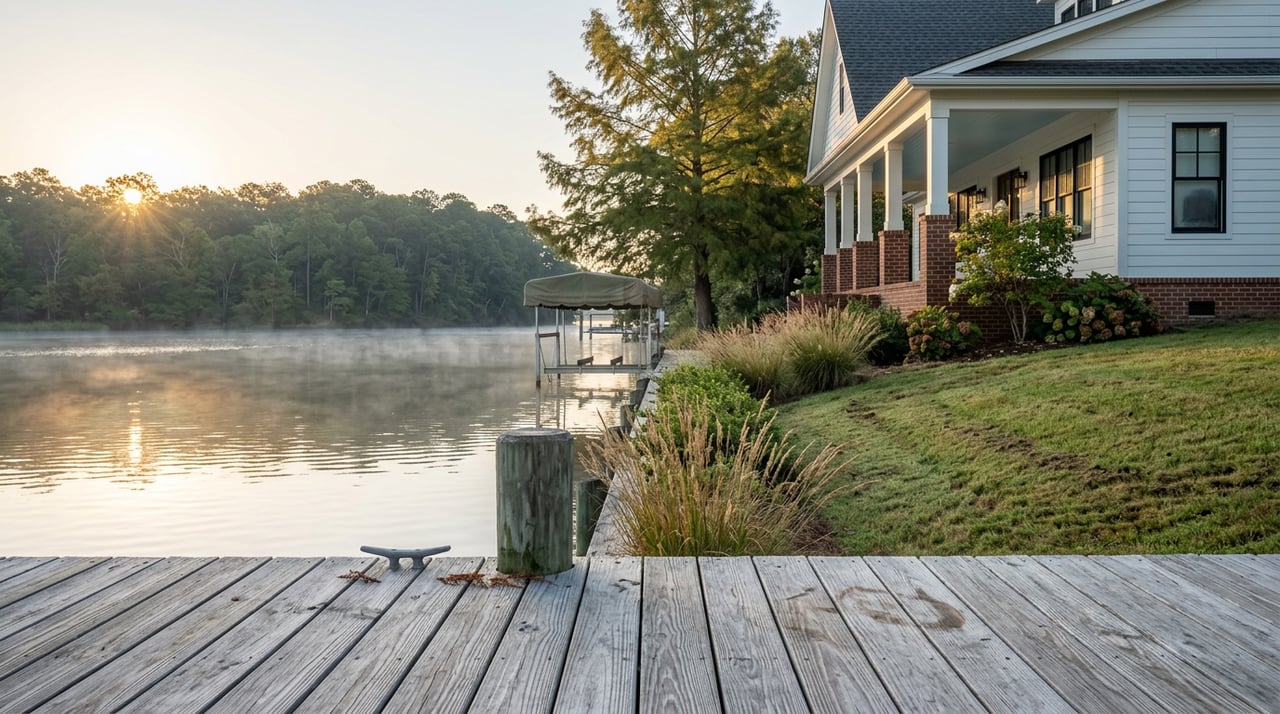
When a buyer tours a lake house, they typically assume everything they see out the back window comes with the sale. The patio. The retaining wall. The dock bobbing at the end of the yard. On most residential streets in Murray or Paducah, that assumption holds. On the Lake Barkley shoreline in Kuttawa, it can be wrong, and finding that out after an offer is accepted is the kind of surprise that stalls a closing.
The dock most buyers picture as a fixed feature of the property is often something closer to a permit, and permits do not automatically follow a deed. On Lake Barkley, that distinction is written into federal shoreline policy, and it shows up in real transactions happening right now in Kuttawa's most popular lake communities.
Kentucky Lake and Lake Barkley sit side by side, connected by a canal, and buyers comparing waterfront homes on both often assume the shoreline rules are identical. They are not. Kentucky Lake's shoreline is managed by the Tennessee Valley Authority, while Lake Barkley falls under the jurisdiction of the U.S. Army Corps of Engineers, Nashville District. That single difference in federal manager changes who reviews a dock application, how the review works, and what happens to a permit when a property changes hands.
Every private dock on the Barkley side operates under a Shoreline Use Permit issued by the Corps' Lake Barkley Resource Manager, not a permit that belongs to the house. According to the Corps' own shoreline management documentation, Shoreline Use Permits are non-transferable and become null and void upon sale or transfer of the adjoining property. A new owner has to submit a fresh application before that dock can legally stay in place under their name.
| Kentucky Lake shoreline | Lake Barkley shoreline | |
|---|---|---|
| Federal manager | Tennessee Valley Authority | U.S. Army Corps of Engineers, Nashville District |
| Governing document | TVA shoreline rules | Lake Barkley Shoreline Management Plan |
| Dock permit at sale | Ask the current permitting agency directly | Void at sale, new owner must reapply |
| Plan review cycle | Set by TVA | Reviewed and updated every five years |
For a buyer shopping both lakes, the practical takeaway is not that one lake is harder than the other. It's that the two shorelines answer to different agencies with different processes, and a dock that looks identical from the water can carry a completely different paperwork trail depending on which side of the canal it sits on.
Buyers who grew up around lakes with less regulation sometimes push back on this the first time they hear it. The dock is right there, tied to the shoreline, wired for electric, sitting on a lift. How could it not just come with the house?
The Corps' own operational management plan for Lake Barkley spells it out. A Shoreline Use Permit becomes void the moment the adjoining property is sold or transferred, or once both the permittee and their legal spouse have died. A new owner may apply for a new permit, but approval is not automatic and depends on how that stretch of shoreline is currently allocated under the plan.
There is one exception worth knowing. Under Public Law 99-662, any boat dock lawfully installed before November 17, 1986 cannot be forced out by the Corps unless it becomes a safety hazard or the owner fails to meet permit conditions, and that structural protection survives a change in ownership. It is a narrow carve-out that protects the physical dock from forced removal. It does not mean the Shoreline Use Permit itself transfers to a new owner, since permits still go void at sale regardless of the dock's age. Most docks going up around Kuttawa today were built well after 1986, so this protection rarely applies to newer construction anyway.
The clearest example of this friction is not theoretical. It is playing out right now in Moon Bay Harbor, one of Kuttawa's best known waterfront communities on the north shore of the lake.
Active listings for Moon Bay condos and villas routinely spell out that a private boat slip is priced and sold separately from the home. As of mid-2026, individual slips in the community's shared dock system have been listed on their own for roughly $45,000 to $50,000, sometimes with a boat lift or jet ski portal included, sometimes not. The home listing itself will often note plainly that "a slip in community dock" or "storage unit" is available for purchase outside of closing, meaning the number on the sale sign is not the whole cost of arriving at Moon Bay with a boat.
This is a different mechanism than the federal permit issue, but it points at the same underlying lesson. In Kuttawa, dock access is frequently structured as its own asset, whether that is a Corps-issued permit tied to a specific parcel or a privately owned slip inside a shared marina system. Either way, a buyer who assumes the listing price includes full turnkey boat access can find themselves negotiating a second line item after they thought they were done negotiating.
Shoreline allocation on Lake Barkley gets revisited on a schedule, not left alone once it's drawn. The Corps reviews and updates the Shoreline Management Plan every five years, and the most recent cycle began with public workshops held in March 2025 in Grand Rivers. That kind of review can reclassify specific coves and shoreline segments, shifting them between categories like protected, limited development for mowing only, or open to private dock facilities.
For a buyer looking at a specific cove or peninsula in Kuttawa, this means the shoreline allocation map is worth checking rather than assuming, especially for undeveloped lots being sold on the promise of future dock access. A parcel that was open to permitting at the last review is not guaranteed to hold that status forever, and a parcel currently restricted could theoretically open up at the next one. Either direction is a reason to verify current allocation with the Resource Manager's office before treating a dock as a sure thing.
A few questions are worth answering before earnest money moves, not after:
Dock permits get the attention because they involve federal land, but they are not the only piece of paperwork that trips up Kuttawa lake buyers. Many homes in Lyon County are not on municipal sewer, which means they run on private septic systems regulated by Kentucky's on-site sewage rules under 902 KAR 10:085. Kentucky sellers are also required to complete a state Seller's Disclosure of Property Condition, which covers known issues with septic, well, and other major systems.
A standard septic inspection in Kentucky typically runs $250 to $600 depending on system complexity, and most systems need pumping every three to five years depending on household size. None of that is unusual for rural Western Kentucky. What is worth flagging is that a lake property with an aging septic system and an unresolved dock permit can stack two separate points of friction into a single closing, and a buyer who only asked about one of them can end up negotiating both at the last minute instead of the first week.
None of this makes buying on Lake Barkley harder than it should be. It makes it a transaction with a few extra steps that a generic home sale on a city lot does not carry. The dock, the slip, and the shoreline allocation are worth treating as separate questions from the house itself, right alongside the septic system and the well. Ask early, verify with the Resource Manager's office where needed, and build those answers into the offer instead of discovering them during due diligence.
Does every home on Lake Barkley in Kuttawa need its own dock permit? Only homes with a private dock on Corps-managed shoreline need an individual Shoreline Use Permit. Homes in shared-dock communities like Moon Bay Harbor typically access the water through a community dock system instead, where individual slips are bought and sold as their own asset.
If a dock was built before 1986, does that protect a new owner too? The grandfathering under Public Law 99-662 protects the physical structure from removal, but it does not automatically transfer the Shoreline Use Permit to a new owner. A new owner still needs to apply for their own permit for that grandfathered dock.
Is this the same on Kentucky Lake? Kentucky Lake's shoreline is managed by the Tennessee Valley Authority rather than the Army Corps of Engineers, which means a different agency, application process, and set of rules apply. Buyers comparing waterfront homes on both lakes should confirm which agency governs the specific shoreline in question rather than assuming the process is the same.
Dock permits, shoreline allocation, and separate slip sales are exactly the kind of detail that gets missed by a buyer working from a listing sheet alone. If you're looking at waterfront property in Kuttawa and want someone who checks these details before you write an offer, not after, Tammy Cothran would love to help. Let's Connect.
Stay up to date on the latest real estate trends.



Supporting life transitions with trusted guidance and thoughtful expertise, ensuring every move feels seamless, well-managed, and handled with care from start to finish—no matter where the journey leads.